Our Story
MORÈRE 1897 was born from the meeting between the history of a French family settled in Vietnam since 1897 and the memory preserved by the M'Nông Chil ethnic group, who saved the Bourbon Pointu plantations from oblivion for more than three decades. This is that story, told by Pierre Morère.
1897: Yersin and the Origins of Dalat
Some dates mark the beginning of a story. 1897 is one of them. My great-grandparents arrived in Vietnam that year. That same year, Dr Alexandre Yersin, physician and bacteriologist who discovered the plague bacillus, but also an explorer, gave the Resident Superior of Indochina a decisive opinion in favour of a plateau he had spotted in 1893: the Lang Bian plateau, 1,500 metres above sea level, with volcanic soils of incomparable richness. This is the site that would become Dalat.
Yersin thought in terms of quality, permanence and respect for climate and soil. He knew this plateau could welcome the noblest, most delicate varieties, those that grow only in exceptional conditions.
The Faraut-Morère Family alongside Yersin
My maternal great-grandparents settled in Hue. Adolphe Faraut, the pioneer, had been sent from France to look after the Emperor's gardens. He later chose to withdraw to the mountains and became one of the first farmers to prosper in the Highlands, near Dalat. He and Yersin were good friends, and it was no doubt on Yersin's advice that he chose to settle up there, at the edge of the known world.
On my father's side, my grandfather Auguste Morère introduced coffee and rubber trees to the Phu Rieng region, in Binh Phuoc province, in the 1920s.
Where Does Bourbon Pointu Coffee Come From?
Bourbon Pointu, or Coffea arabica var. laurina, is a variety originating from Ethiopia and Réunion Island, where it was discovered in the 18th century. It stands out for its long, pointed beans and above all for its exceptionally low caffeine content: around 0.6%, compared with 1.2% for a classic arabica. This gives it a natural sweetness and a round, bitterness-free mouthfeel, with an aromatic profile of great finesse: floral notes, crystalline acidity and an exceptionally long finish.
The Faraut family settled in Dalat before 1915. A few years later, they began growing Bourbon Pointu in the Highlands, persuading the local people of Dalat and Da Sar to plant coffee around the village. Bourbon Pointu is not an easy coffee: its yields are low and its climate requirements strict. But Dalat had everything it needed: altitude, cool nights, morning mists, volcanic soils and forest cover.
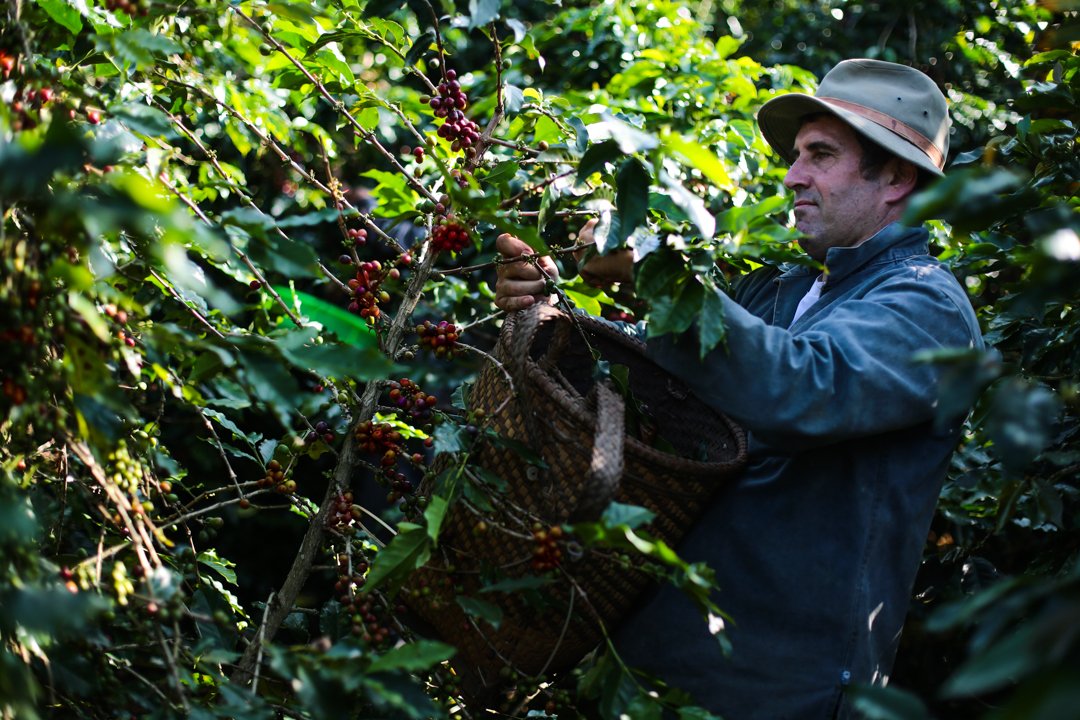
Bourbon Pointu cherries are picked exclusively by hand.
Why Is Bourbon Pointu So Rare?
Today, this almost vanished variety is found in only a few terroirs worldwide. Several reasons explain its rarity:
- Extremely low yields: a Bourbon Pointu tree produces about 150 grams of green coffee a year, compared with 300 grams for a standard variety.
- Strict climate requirements: an altitude of 1,200 to 1,600 metres, cool and stable temperatures, a wide day/night temperature range and rich volcanic soils.
- Indispensable ancestral know-how: only the peoples of the Highlands, including the M'Nông Chil ethnic group, who have worked this terroir for generations, still fully possess it.
1976: The Forced Abandonment of the Plantations
The family plantation prospered until the 1970s. Then the Vietnam War turned everything upside down: my parents carried on their work for as long as they could, before having to leave the country in 1976. The plantations did not disappear: they were swallowed up by the forest or absorbed by economic development. For more than three decades, the coffee trees survived in a semi-wild state in the tropical rainforest, protected by the canopy and nourished by the basalt soils of the Red Lands.
But the M'Nông Chil ethnic group did not forget. They kept the exact memory of where these plantations stood, passed down from generation to generation.
Who Is the M'Nông Chil Ethnic Group?
Some encounters mark a lifetime. Meeting the M'Nông Chil ethnic group was one of them. In 2007, I returned to the family lands and found the community of the village of Da Sar, who had worked with my grandparents. The region, closed to foreigners at the time, had been spared from runaway urbanisation.
It was the M'Nông Chil ethnic group who guided me through the forests and high hills in search of the century-old coffee trees. Without their memory and their intimate knowledge of the land, I would never have found these trees scattered across the mountain. It was even the community that asked me to preserve and promote this coffee: they did not want this story to disappear.
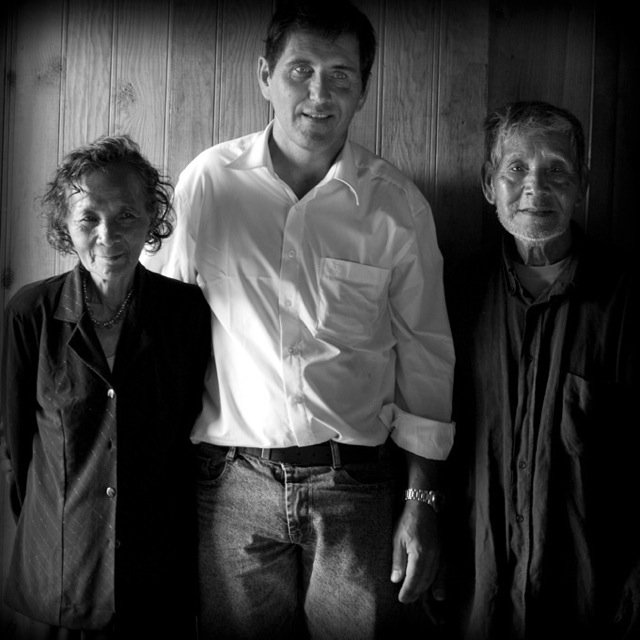
Pierre Morère with Ka'Bang (left) and Ha'Bang (right), members of the M'Nông Chil ethnic group in Da Sar, keepers of the memory of the plantations (2015).
I then spent eight years with them relearning traditional growing methods, before rebuilding my grandfather's plantation, respecting ancestral methods, in agroforestry, while preserving the evergreen forest.
A Shared Fight for the Primary Forest
Our project goes beyond simply producing coffee. Our plantation lies at the gates of Bidoup Nui Ba National Park, 65,000 hectares of forest on the outskirts of Dalat. All around, hectares of plastic greenhouses are eating into farmland and pushing agriculture up into the mountain forests, causing soil erosion and loss of biodiversity. Preserving Bourbon Pointu also means preserving this ecosystem, a mission that is part of my values.
A Coffee Recognised by the Finest Tables
Bourbon Pointu Morère 1897 was encouraged by Pierre Gagnaire, three-Michelin-star chef, and praised by Jacques Pourcel, also three stars. It was distributed by Annam Gourmet and selected by La Grande Épicerie de Paris for its exceptional tastings. But beyond this recognition, what matters is the story: a human alliance between two cultures, and several generations living in Dalat.
Today, this story continues in every cup. Discover Bourbon Pointu and the exceptional coffees of the Morère family.
Discover our coffeesFrequently Asked Questions
What Is Bourbon Pointu Coffee?
It is a rare variety of arabica coffee (Coffea arabica var. laurina), originating from both Ethiopia and Réunion Island, recognisable by its long, pointed beans and its low caffeine content, which gives it a round mouthfeel without bitterness.
How Did Bourbon Pointu Arrive in Vietnam?
It arrived in Vietnam in 1897 through the Saigon Botanical Garden, thanks to Dr Alexandre Yersin (source: Teston and Percheron, L'Indochine moderne, 1930). Adolphe Faraut then introduced it to the Highlands in Dalat before 1915.
Who Is Pierre Morère?
A descendant of the Faraut-Morère family, settled in Vietnam since 1897, Pierre Morère found the family plantations abandoned since 1976 in 2007, thanks to the memory preserved by the M'Nông Chil ethnic group in the village of Da Sar.
Why Is Morère 1897 Bourbon Pointu So Rare?
Production remains confidential, a few hundred kilos a year, because of the tree's very low yields, exclusively manual harvesting and bean-by-bean sorting, carried out using artisanal methods, in agroforestry, in tropical rainforest.