Some encounters mark a lifetime. Meeting the M’Nông Chil ethnic group was one of them.
My family, Faraut on my mother’s side and Morère on my father’s, has been established in Vietnam since 1897. I reconnected with this history in 2007, through a project centred on specialty coffee, honey and the Peoples of the Highlands. This return to my roots was much more than a simple journey. It was a reconnection with a past I carried within me without really knowing it.
Return to the Village of Da Sar
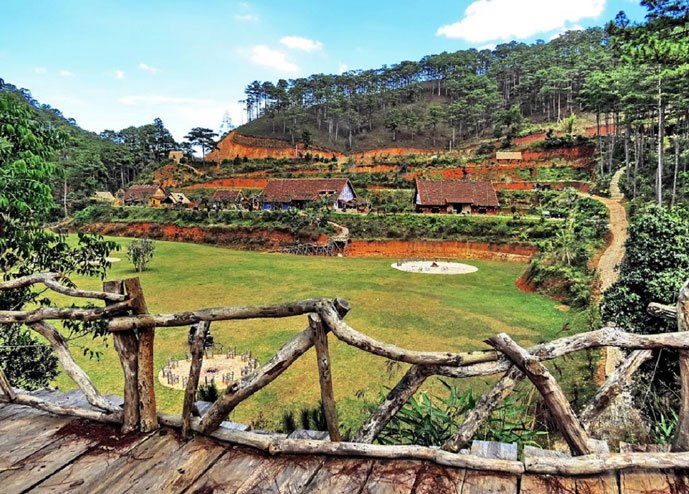
The village of Da Sar stands at 1,500 metres in the Central Highlands of Vietnam, 20 km east of the city of Dalat. It was here that my maternal great-grandfather, Adolphe Faraut, had settled before 1897, alongside Dr Alexandre Yersin, a pioneer in surveying the Lang Bian plateau and in the decision to create the city of Dalat, where he never fully settled, remaining loyal to Nha Trang. It was here that he would introduce Bourbon Pointu, this rare variety endemic to Réunion Island.
Historical background: In 1976, my family had to leave Vietnam. The plantations were abandoned. For more than three decades, the coffee trees survived in a semi-wild state in the evergreen forest.
When I returned to the family lands in 2007, I went back to the ethnic community of the village of Da Sar who had worked with my grandparents. They welcomed me into their village. The region, closed to foreigners at the time, has remained somewhat spared from the runaway urbanisation that disfigures other parts of the Highlands.
Living Memory
It was the M’Nông Chil ethnic group who taught me to know nature. They guided me through the many forests and high hills in search of the trees of the precious Morère 1897 Bourbon coffee, which had been abandoned for more than three decades. Without their memory, without their intimate knowledge of this land and of the way they travel it – whether uphill or downhill, there are no detours, no bends, in the imagination as in the reality of the peoples of the plateaus – I would never have found these century-old coffee trees scattered across the mountain, hidden deep in the riparian and tropical rainforests of Vietnam’s vast landscapes.
They had kept the memory of the exact location of these plantations. This knowledge had been passed down from generation to generation. It was this loyalty to history, this ability to preserve the memory of a bygone era, that touched and moved me so deeply that I decided to stay and live among them.
An Unexpected Request
It was the M’Nông Chil ethnic group community who asked me to preserve and promote this Bourbon coffee. They did not want this story to disappear. They saw in me a chance to bring back to life a project that had shaped their village and their relationship with this terroir, and it happened!
So I decided to rebuild a coffee plantation, my grandfather’s. But not just any way. Respecting ancestral methods, growing in agroforestry, preserving the pine forests and evergreen forests that surround the coffee trees.
Eight Years of Apprenticeship
I spent eight years with the M’Nông Chil ethnic group relearning traditional coffee-growing methods; eight years understanding this unique terroir, observing their gestures, learning their intimate knowledge of the mountain, while growing my own coffee trees under their many pieces of advice. I made plenty of mistakes; I farmed land that gave too little satisfaction because of poor orientation, poor soil or insufficient altitude. Today, the experience has been taking shape for twenty years and I am still by their side; my plantation – miir in the local language – bears every kind of memory of it, its wrinkles and its scars.
“The M’Nông Chil ethnic group know when to harvest, how to select cherries at perfect ripeness, how to respect the natural rhythms of the plant and the forest. This knowledge cannot be improvised. It is passed on, it is lived, it is acquired and improves with daily experience in contact with the land.”
What I express here is not just words. It is also recommendations, growing advice and projects carried out together. How many times I was held back at my plantation, forbidden to go and sell my coffee stock myself because the middleman was not trustworthy, or because the market was trending upwards and it was better to wait. I have gathered a whole bag full of caring moments, like the warning from Duy not to cross the forest between the town and the village at night carrying the workers’ pay, for fear of being attacked. Until I was home, the villagers kept watch and waited for my signal: “That’s it! I’ve arrived safely.” My memory is full of such moments, and it is thanks to it, but also to them, the M’Nông Chil ethnic group, that I have made this profession a way of life; one that has transformed me and made me the man I am.
The harvest is done exclusively by hand. Every cherry is carefully chosen. This rigorous selection is the first guarantee of quality for the Morère 1897 Bourbon Pointu we produce today.
A Shared Fight
Our project goes far beyond simply producing coffee. Together, we are fighting to protect the environment and in particular to combat the runaway deforestation in this region. All around us, hectares of plastic-covered greenhouses are being set up to grow cut flowers. These vegetable and flower crops push farmland out of the valleys and up into the mountain forests, which are gradually cleared and terraced. This agro-industrial landscape causes soil erosion and loss of biodiversity, and accentuates climate change.
We take part in developing and preserving ecosystems, all the more so as our plantation lies at the gates of Bidoup Nui Ba National Park, 65,000 hectares on the outskirts of the city of Dalat. It is an essential fight. It is not the only one, but this one is fierce and difficult, and to take it on, I had to arm myself.
Arming myself meant first of all training: a degree in anthropology at the University of Strasbourg, a master’s degree in ecotourism in 2000 at the University of Avignon, and a doctorate in Asian history and biodiversity at Aix-Marseille University, with the IRASIA and LPED laboratories under joint supervision, because the stakes are high. My thesis subject is “The history of a forest in the Highlands of Vietnam: perception and management of biodiversity from the colonial era to the present day”, supervised by Philippe Le Failler, director of the École Française d’Extrême-Orient (historian) in Hanoi, and Bruno Vila (ecologist), director of the former colonial museum of Marseille, with the defence planned for late 2027. This is what I call arming myself: expertise forged to match a life project!
Through this ambition, the M’Nông Chil ethnic group community can increase its chances of maintaining its autonomy. They can free themselves from the debts owed to coffee middlemen. They can resist the land pressure that intensive greenhouse farming puts on their village.
More Than a Coffee, an Alliance
Morère 1897 Bourbon Pointu was encouraged by my friend Pierre Gagnaire; my plantation was visited by Jacques Pourcel and his team, and our coffee was distributed by Annam Gourmet, at La Grande Épicerie de Paris. But beyond this recognition, what matters is the story. The story of an alliance, of a strong bond, of a social, human and caring pact between two cultures.
It was in the village of Da Sar, the M’Nông Chil ethnic group village that was still closed to foreigners in 2007, that I chose to settle, and I still live there today. My plantation flourishes in the commune, at the gates of Bidoup Nui Ba National Park.
“Without the M’Nông Chil ethnic group, Morère 1897 Bourbon Pointu from Dalat would never have been saved from oblivion. Without their memory, their loyalty and their request to preserve this heritage, nothing would have been possible. I owe them everything!”
Every cup of our coffee tells this story, and I encourage you to come and drink it here when the time comes. Every bean carries the memory of their terroir, the loyalty of a people and the alliance between people and nature. To learn how to prepare it properly, see our tasting guide.